Can you imagine? All those diets where you starved yourself, suffered through hunger, and fantasized about breadsticks? Totally unnecessary. You didn’t need to suffer. You didn’t need to feel hungry. You just needed more spinach and fewer empty promises.
The Real Reason for Weight Gain
People don’t get fat because they eat too much food, they get fat because they eat too much of the wrong foods. Diets rich in fat, oil, and refined carbohydrates—the usual culprits hiding in processed and low-nutrient animal foods—are what pack on the pounds.
If you load up on nutrient-rich, fiber-packed, plant-based foods, you can eat to your heart’s content, never feel hungry, and still lose weight. That’s not a trick—it’s science. And at Fofolebo, we optimize that science for your unique goals, so it works even better. Here’s how it works.
Your body has two key hunger signals working behind the scenes:
- Nutrient Sensors: Your stomach monitors the vitamins, minerals, and overall nutrition in the food you consume. If your meal is low in nutrients (think meat, dairy, and processed foods), these sensors send a signal to your brain saying, “Keep eating—we need more.” So you end up consuming more calories. You can try to resist, but in the end it’s a losing battle. Your body will crave the nutrients it needs, and overtake your willpower forcing you to consume more calories, and you’ll gain weight.
- Stretch Receptors: These tell your brain when your stomach is physically full. Eat too little and you’ll feel hungry. This is why diets that restrict the quantity of food you eat never work in the long run. Did you know that 98% of those who lose weight, usually through a great deal of suffering and deprivation, gain it all back within 2 years?
The Secret Sauce: Calorie Density
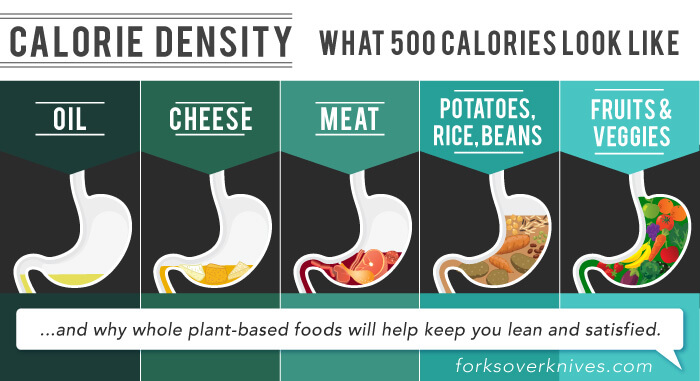
The secret to weight loss can be distilled into 2 words and it’s not “eat less” or “exercise more,” and it’s certainly not “gastric bypass;” it’s calorie density.
Want to lose weight without the hunger pangs? Eat low-calorie-density fiber-packed foods that are high in nutrients. That way, you’re full without consuming too many calories.
What foods have the lowest calorie density? As luck would have it, they’re also the healthiest foods on the planet: vegetables, fruits, whole grains, and legumes. These four powerhouses—known as the new food groups, thanks to Dr. Neal Barnard of the Physicians Committee for Responsible Medicine—were created in response to the USDA’s outdated and misleading food pyramid.
Unprocessed whole plant foods in these categories have calorie densities ranging from 100 to 600 calories per pound. If you keep the average calorie density of your meals under 567 calories per pound, you’ll naturally lose weight, maintain a healthy body weight, and never feel hungry. No weighing, no measuring, no starving, no counting. Just a nourishing diet that fuels your body, sheds pounds, and leaves you satisfied after every meal.
For the same number of calories, some foods will have a small effect on satiety, while others a large one. The key to losing weight is to be smart with your food choices. Good food choices help you control hunger, eat fewer calories, and lose weight.
Most people eat roughly the same weight of food every day. The difference? People who eat plant-based consume far fewer calories compared to those who eat meat, dairy, and processed foods.
Most diets ask you to eat less. That’s like asking you to breathe less—good luck with that. Eventually, your body rebels, and you binge on high-calorie junk. But when you focus on nutrient-dense foods, you bypass the struggle altogether. The average overweight person eating to full satiation on a whole-food plant-based diet will lose 5-10 pounds per month, and keep it off. Even better when the portions and ingredients are tailored to you.
The Calorie Density Line-Up: How Much Bang Are You Getting for Your Bite?
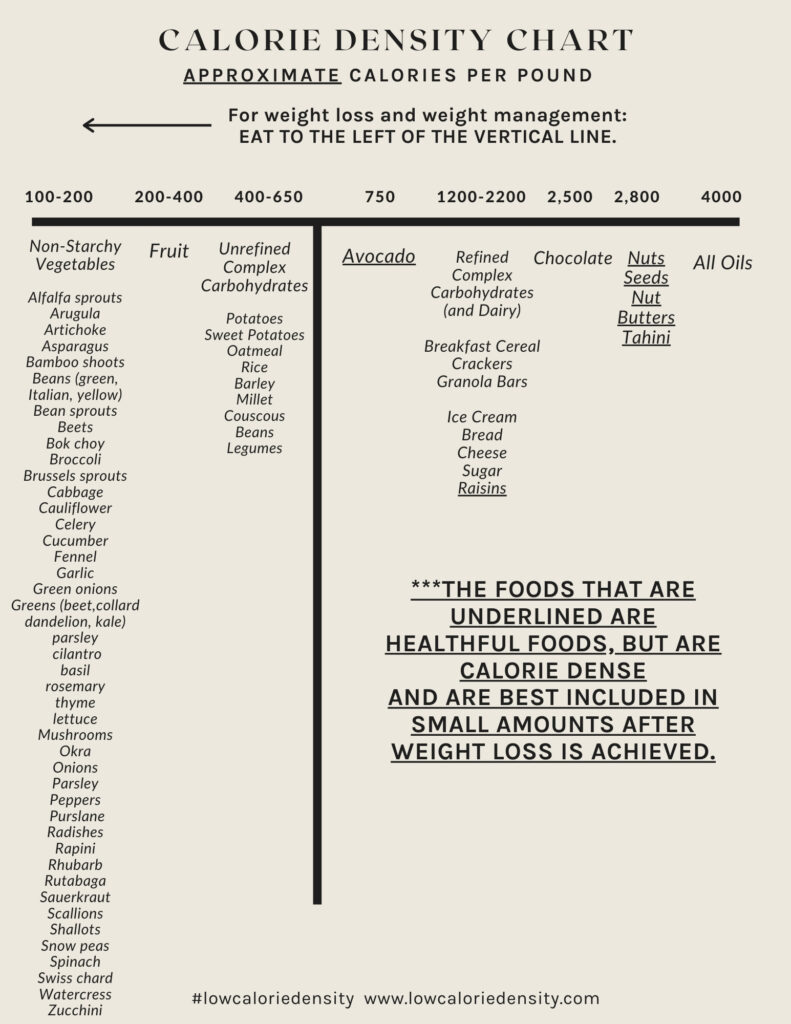
Most Americans are getting the majority of their calories from foods to the right of the vertical line—foods that contribute to weight gain and health conditions. Not surprisingly, about 75% of Americans are overweight and more than half of those are obese. To lose weight, shift your eating left of that line, where plants reign supreme. Eat foods that come from a plant, not that are manufactured in a plant.
Why Oil Can Sabotage Your Weight-Loss Efforts
Oil is 4,000 calories per pound. Let that sink in. No fiber. No nutrients. No satiety signals. It doesn’t activate your stretch receptors or nutrient sensors, meaning you can consume boatloads without feeling full. Basically, oil is the worst “food” on the planet. It’s a nonnutritive, disease promoting toxin that will make you sick and fat. Give it up.
Why Juicing Isn’t the Shortcut You Think
Juicing sounds healthy, right? But blending fruits and veggies strips them of fiber and bulk, which are essential for triggering your stretch receptors. Without that bulk, you won’t feel satisfied and you’ll end up eating more calories. Take it from science: eat your fruit and veggies, don’t drink them.
Why Animal Products and Processed Foods Keep You Hungry
Fiber is the unsung hero of weight loss. It slows digestion, keeps you full longer, and stabilizes your blood sugar. Fiber is bulk, so without it your stretch receptors don’t get triggered and you end up eating more. Animal products contain zero fiber. Processed foods? Barely any fiber. And here’s the kicker—animal products and processed foods are typically high in calorie density too, making it a double whammy: you’re eating more, and each bite is packing extra calories. Since these foods are also nutrient-deficient, they don’t activate your nutrient sensors either. The result? You keep eating, but you’re never truly satisfied. It’s an endless loop of overeating with none of the nourishment your body actually craves.
The Truth About Nuts, Seeds, and Avocados
Nuts, seeds, and avocados may be plant-based, but they come with a catch: they’re high in calorie density, which can be problematic if you’re trying to lose weight. There are two key issues. First, their high calorie density means even small portions pack a lot of calories. Second, they can act as trigger foods—highly addictive for some people, leading to cravings for even more calorie-dense foods.
Many experts recommend eating nuts daily for their health benefits, and that’s great—unless you’re a food addict or actively working on weight loss. In that case, it’s best to eliminate them.
At Fofolebo, personalize the precise amount of nuts, seeds, and avocados based on your gaols and profile.
Break the Cycle of Craving High-Calorie Junk
Most people gravitate toward foods on the right side of the vertical line—high-calorie, low-nutrient, low-fiber options that pack on pounds. Why? Because they’re designed to taste better. The more you eat them, the more you crave them. It’s a cycle driven by habit, not hunger.
Here’s the truth: We develop a taste for the foods we eat regularly. Aside from breast milk, every food preference is learned. The good news? You can unlearn cravings. With 1-2 months of plant-based eating, your taste buds will start to favor the nutrient-rich, satisfying foods your body actually needs—and you’ll stop missing the ones that don’t serve you.
Actionable Takeaways to Start Today:
- Fill Your Plate with Plants: Pile on the veggies, beans, and whole grains. Think big, colorful bowls without the calorie-laden dressings. Think fofolebo.
- Chew, Don’t Sip: Skip juices and smoothies. Eat whole fruits instead.
- Ban the Bottled Oil: Use healthier alternatives for flavor, like balsamic vinegar, lemon juice, or tahini.
- Love Fiber: It’s the secret weapon that keeps you full and your cravings in check.
With Fofolebo, Eating More Means Losing More
Fofolebo is your partner in guilt-free eating and weight loss. Our hearty and fully satisfying personalized plant-based meals are designed to be low in calorie density and high in nutrients, so you can eat more, weigh less, and love every bite. We take care of the planning and preparation—all you have to do is enjoy the food and feel great.
The Bottom Line; Fill up and Slim Down
Forget calorie counting, crash diets, and hunger pangs. The real path to weight loss is simple: Eat more plants, preferably where portion sizes and ingredients are calibrated for your activity level and health profile. Shift your plate to the left of the calorie-density line, and let nature do the rest. You’ll lose weight without even trying—and you’ll feel amazing while doing it.